
Finishing detox feels like crossing a finish line. You made it through the shaking, the sweats, the sleepless nights, and whatever else your nervous system decided to throw at you during withdrawal. That’s genuinely hard, and it deserves to be acknowledged.
But detox isn’t the finish line. It’s closer to the starting block.
Alcohol detox near you addresses one very specific problem: getting alcohol out of your body safely while managing the physical withdrawal symptoms that come with stopping heavy drinking. What it doesn’t do is touch the triggers, the habits, the stress responses, or the deeper psychological patterns that fuel alcohol use disorder in the first place. Those are still there. And if nothing addresses them, returning to old routines becomes a very short road back to drinking.
Most people who complete detox and step directly back into their regular lives without continued support relapse. That’s not a moral failing — that’s the predictable outcome of treating a complex, chronic condition with only its first intervention. The Mayo Clinic and the American Psychological Association both emphasize that alcohol use disorder requires ongoing therapeutic work well beyond physical stabilization, because the psychological dependence and neurobehavioral changes underlying AUD don’t resolve when the last drink leaves your bloodstream.
So what happens after alcohol detox? The honest answer: a lot, and it varies by person. Kora Behavioral Health works with people at exactly this point — after detox, helping them figure out what structured care makes sense next.
Why Detox Alone Can Leave You Exposed
There’s a version of this story a lot of people tell themselves: “I just need to get through withdrawal, and then I’ll be fine.” The logic makes sense on the surface. Get the toxin out, reset the body, start fresh. Clean slate.
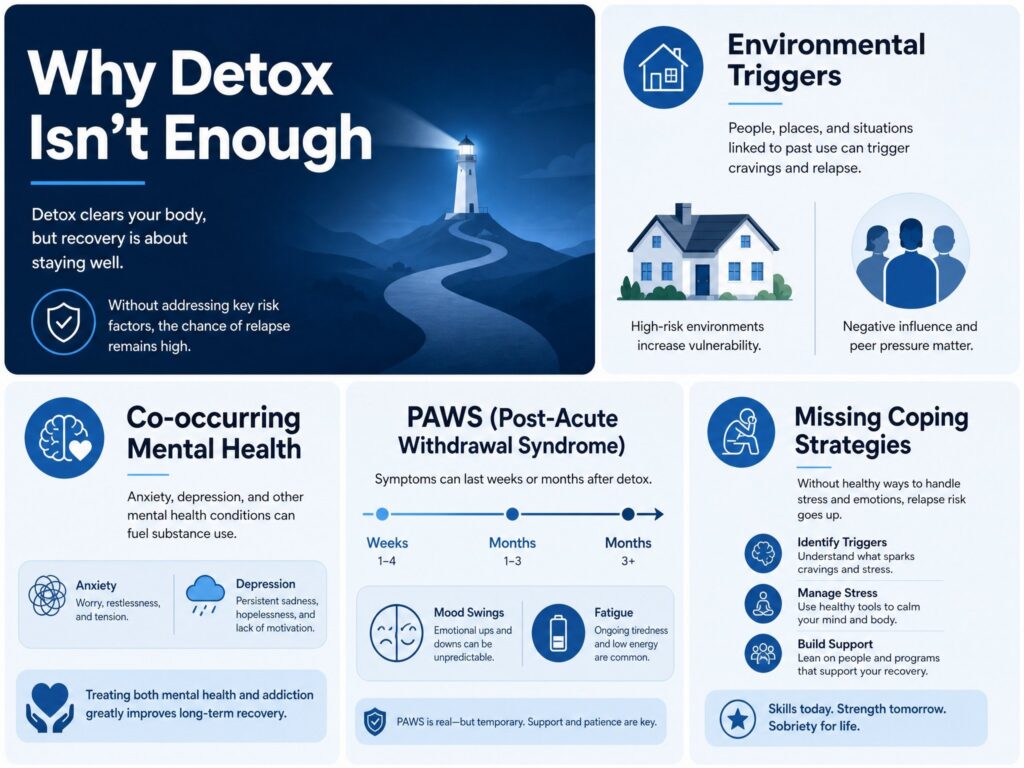
The trouble is, alcohol use disorder isn’t primarily a toxin problem. The physical dependence is one layer. Underneath that are behaviors built over months or years — the way a certain kind of stress makes you reach for a drink, the social environments that normalize it, the way alcohol has functioned as a crutch for sleep, or mood regulation, or just getting through the day. Detox doesn’t touch any of that.
What actually puts people at risk after detox:
- Returning immediately to the same home environment, same social circles, and same stressors that surrounded the drinking
- Unaddressed mental health concerns like depression or anxiety, which frequently co-occur with heavy alcohol use and intensify during early sobriety
- No coping strategies for cravings and urges when they resurface
- Post-acute withdrawal syndrome (PAWS), where mood swings, fatigue, and sleep disruption continue for weeks or even months after physical withdrawal ends — a result of the brain’s prolonged neurochemical recalibration
That last one is worth sitting with. A lot of people expect to feel dramatically better once detox is over, and when PAWS symptoms linger, it can feel like something went wrong. Nothing went wrong. The brain had adapted to heavy alcohol use over a long period, and reversing that adjustment takes time. What PAWS can do, though, is make early recovery feel unstable — which is exactly when external structure and support matter most.
Detox Is the Beginning, Not the Finish Line
Physical stabilization and long-term recovery are two different things. Detox achieves the first. Everything that follows — the therapy, the behavioral work, the environment changes — builds toward the second. The gap between those two things is where relapse tends to happen, and closing that gap is what continuing care is designed to do.
The Levels of Care That Come After Detox
Treatment after detox is not one-size-fits-all because people have different recovery needs, support systems, and levels of risk. Someone leaving detox after severe alcohol withdrawal with limited support at home may need a different level of care than someone with a stable environment and strong recovery resources.
A clinical assessment at this stage is not just a formality—it helps determine which treatment approach best fits your situation, goals, and long-term recovery needs.
The general continuum looks like this: detox feeds into more intensive structured treatment, which gradually steps down in intensity as stability builds, eventually connecting to ongoing outpatient support and aftercare.
| Level of Care | Structure | Best For |
| Partial Hospitalization Program (PHP) | Full-day programming, several days per week | High-need individuals leaving detox who aren’t ready for independent living |
| Intensive Outpatient Program (IOP) | Several hours per day, more schedule flexibility | People balancing work or family while maintaining recovery support |
| Sober Living | Structured residential environment, peer accountability | Those who need a recovery-supportive setting before returning home |
| Outpatient Therapy / Aftercare | Ongoing individual or group therapy | Long-term maintenance and relapse prevention |
A clinical team determines where someone enters this continuum. There’s no wrong answer, and moving between levels as needs change is expected — that’s what “step-down” care means.
PHP After Detox: When You Need Real Structure
Partial hospitalization is the most intensive post-detox option short of residential care, and for a lot of people finishing alcohol detox, it’s the right fit. PHP involves showing up for structured programming during the day — therapy, behavioral health support, relapse prevention planning, skills development — and then returning home or to sober living in the evenings.
The value isn’t just the therapy hours. It’s the daily accountability. When you’re newly out of detox, the gap between “how I feel at 10am in a therapeutic setting” and “how I feel at 9pm alone with my thoughts” can be enormous. PHP fills that gap during the most vulnerable stretch of early recovery.
Who May Benefit From PHP?
People who’ve just completed detox and have significant withdrawal history, limited home support, or a previous relapse after detox often benefit most. If going back to a normal schedule immediately feels like too much — if the structure feels necessary rather than optional — that’s a good indicator that PHP-level care makes sense. Kora Behavioral Health’s PHP program is designed for exactly this transition.
IOP: Structured Recovery Without Putting Life on Hold

Not everyone can step away from work, family, or other obligations for full-day programming. Intensive outpatient programs exist for that reality. IOP typically involves several hours of structured therapy and group support spread across multiple days per week, which means someone can continue working or managing family responsibilities while still receiving meaningful treatment.
The focus areas in IOP — coping skills, emotional regulation, relapse prevention, building support networks — are the same core work as PHP. The difference is the time commitment and the level of built-in structure. IOP assumes slightly more stability than PHP requires, but it still provides far more scaffolding than simply stopping after detox and attending a weekly therapy session.
PHP vs. IOP: Understanding the Difference
| PHP | IOP | |
| Daily time commitment | Full-day programming | Several hours |
| Schedule flexibility | Low | Moderate to high |
| Level of structure | High | Moderate |
| Best transition from | Detox or inpatient | PHP or stable home environment |
Both are legitimate pathways after detox. The right choice depends on what life looks like outside the program and how much external structure recovery currently requires.
Sober Living and Why Environment Isn’t a Small Detail

Finishing detox and walking back into the same house, the same neighborhood, the same social dynamics that surrounded years of heavy drinking is a lot to ask of someone in early recovery. The brain is still recalibrating. Cravings are still showing up.
Stress still triggers old impulses. And all of that hits differently when you’re surrounded by familiar cues associated with drinking.
Sober living provides an alternative: a recovery-focused residential environment with peer accountability, house structure, and separation from high-risk settings. It’s not a treatment program in the clinical sense — there aren’t therapists running groups in the living room — but the environment itself is part of the treatment.
The people around you are in recovery too. The norms of the house support sobriety. That matters enormously when the nervous system is still learning what normal feels like without alcohol.
Why Environment Matters After Detox
Returning to old routines isn’t inherently a failure of willpower — it’s a neurological challenge. Environments hold powerful cues, and alcohol-associated cues (people, places, emotional states) activate craving responses in the brain even after physical withdrawal ends. Sober living interrupts that pattern long enough for new habits and coping strategies to actually take root. Kora Behavioral Health’s sober living options are designed to support exactly this transitional stretch.
Building a Relapse-Prevention Plan That Actually Works
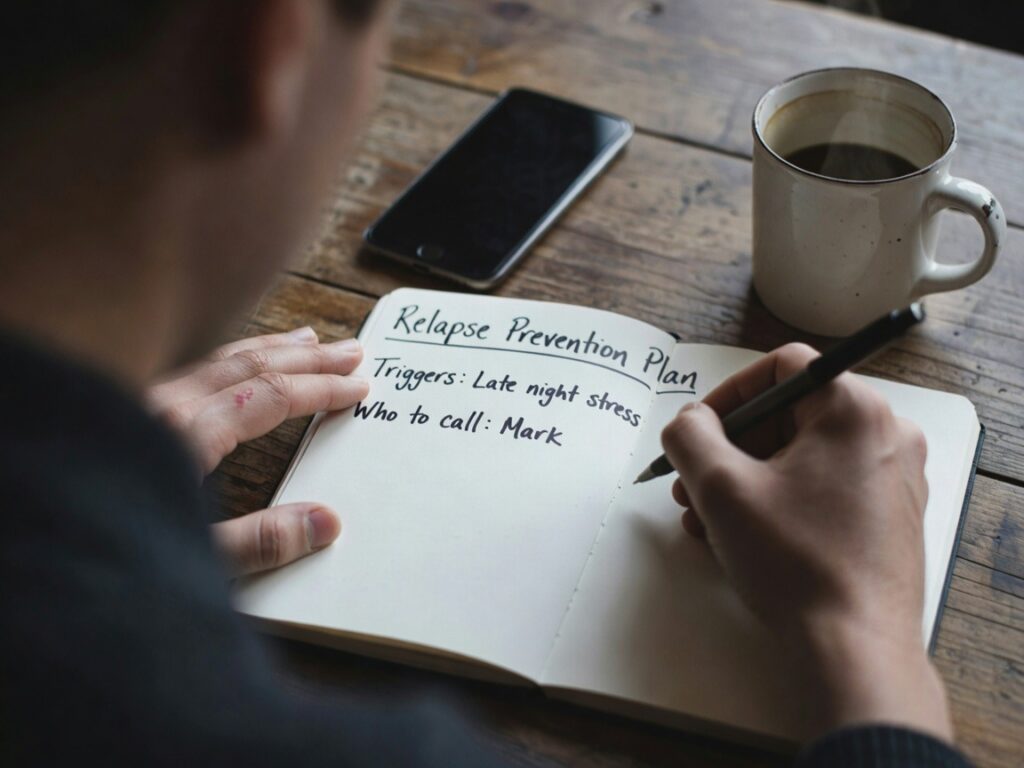
Relapse prevention isn’t a mindset. It’s a concrete, practical plan that anticipates the hard moments before they arrive. The people who navigate early recovery most successfully aren’t the ones who simply decide harder to stay sober — they’re the ones who have already thought through what happens when the urge hits at 11pm on a Tuesday.
A realistic post-detox relapse-prevention plan covers:
- Identifying specific personal triggers — stress types, emotional states, social situations, physical cues — and having a response prepared for each
- Knowing exactly who to call when craving gets loud, not a vague “reach out to someone” intention but an actual name and number
- Continuing therapy beyond the initial treatment phase, because the psychological work of recovery doesn’t wrap up neatly when formal programming ends
- Recognizing early warning signs of relapse — which often show up as mental and behavioral shifts weeks before an actual drink
The NIAAA’s guidance on evidence-based alcohol use disorder treatment consistently emphasizes that ongoing outpatient care and structured aftercare dramatically improve long-term outcomes compared to detox alone. That’s not a controversial finding — it’s one of the most replicated conclusions in addiction medicine.
Recovery Is a Process, Not a Single Decision
Asking for support at week six of sobriety isn’t starting over. It’s the process working as intended. AUD is a relapsing-remitting condition, which means the goal isn’t perfection — it’s building the skills, environment, and support systems to reduce the frequency and severity of setbacks and keep moving forward.
Choosing Your Post-Detox Path
Kora Behavioral Health alcohol detox recognizes that there is no single right answer for what comes after detox, and anyone who suggests otherwise is oversimplifying a complex process. What matters is an honest assessment of each person’s situation: How severe was the alcohol use? What does the home environment actually look like? Are there co-occurring mental health concerns like depression, anxiety, or trauma that need to be addressed alongside alcohol use disorder? What work and family responsibilities need to be considered when planning the next step in care?
Those questions shape which level of care makes sense. A clinical team’s job is to help answer them without judgment and match people with the support that fits their actual situation, not an idealized one.
Kora Behavioral Health offers PHP, IOP, and sober living options specifically designed for people navigating this transition. If you’ve completed detox and are trying to figure out what step comes next, that’s exactly the conversation worth having.
Call (866) 861-9667 or explore how Kora’s PHP and IOP programs connect to continued recovery after detox.
FAQs
Do I need rehab after detox?
When asking do I need rehab after detox, it’s important to understand that detox is only the first step. Detox helps manage withdrawal and physical dependence, but it does not address the underlying triggers, behaviors, or emotional factors connected to alcohol use disorder.
Many people benefit from continued treatment after detox to build coping skills, reduce relapse risk, and create a sustainable recovery plan. The next level of care may look different for everyone, including PHP, IOP, or outpatient therapy, depending on individual needs and clinical assessment.
Why do people relapse after detox?
Several things converge to make early post-detox recovery genuinely difficult. Returning to the same environments and social situations associated with drinking activates craving responses that detox alone doesn’t eliminate. PAWS symptoms — mood instability, sleep disruption, fatigue — can persist for weeks or months, creating ongoing vulnerability. Unaddressed mental health concerns continue generating the emotional discomfort that drinking previously managed. Without new coping strategies and an accountable support structure, the path back to drinking is shorter than most people expect. This is why continuing care after detox isn’t optional for most people — it’s what fills the gap.
What’s the difference between PHP and IOP?
PHP (Partial Hospitalization Program) involves full-day structured programming several days per week and is typically the more intensive option, suited for people coming directly out of detox who need significant daily support. IOP (Intensive Outpatient Program) involves fewer hours per day with more schedule flexibility, making it workable for people who have work or family obligations but still need structured recovery support. Both include therapy, relapse prevention work, and skills development — the difference is primarily in time commitment and the degree of structure. Many people transition from PHP to IOP as their stability in recovery builds.


